
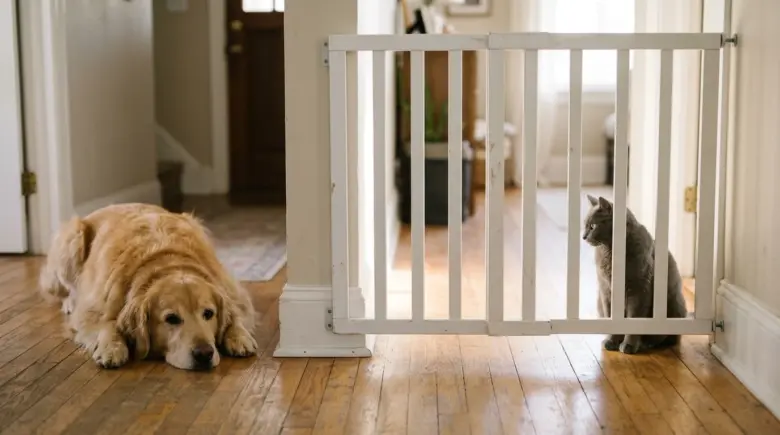
Here is how to introduce a cat to a dog safely: go slowly and in stages. Start with separate spaces, swap scents, let them see each other through a barrier, and only then hold short meetings with the dog on a leash. Give the cat an escape route at every stage, and go back a step if either animal gets tense.
Do not let them “sort it out themselves.” Cats Protection, a UK cat welfare charity, puts it plainly: a controlled introduction is much easier to manage than a damaged relationship is to repair. A bad first meeting can teach the cat to fear the dog and teach the dog that chasing is exciting.
Before you start: check the dog and the setup
The work begins before the two animals are in the same house. Your dog should respond to “sit,” “down,” and “come,” and be able to settle. If those skills are shaky, spend a week or two on them first. Our guide to getting a dog to respond to cues is a good place to start.
Think honestly about each animal’s history as well. Age, health, personality, and past experience all matter, and previous good experiences with the other species may help. A dog with a strong history of chasing or harming cats is a different situation, and needs help from a qualified, reward-based professional before any meeting.
| Stage | What happens | Move on when |
|---|---|---|
| 1. Separate spaces | Cat in a safe room, dog elsewhere | The cat eats and uses the litter box normally |
| 2. Scent swap | Exchange cloths with each animal’s scent | Both ignore or calmly sniff the cloth |
| 3. Barrier viewing | See each other through a gate or glass door | The dog can look away and take a treat |
| 4. Leashed meeting | Short session with the dog on a leash | Both stay relaxed for the whole session |
| 5. Longer sessions | Repeat with a little more freedom | No chasing, staring, or hiding |
| 6. Supervised life | Shared time with an adult present | Calm routines hold up over weeks |
Stage 1: Set up separate spaces
Create a safe room the dog cannot enter, ideally a spare room away from noisy appliances and busy parts of the home. It needs a bed, a litter tray, food and water, and a place to hide, such as a cardboard box with holes cut in it.
If the dog is the newcomer, section off part of the house for the dog instead. Avoid limiting a dog to a very small space, since frustration works against you. Let the cat settle fully before moving on. A cat that eats, plays, and uses the litter tray normally is ready.
Stage 2: Swap scents
Take two clean cloths, one for each animal. Gently rub each animal with its own cloth, then place the cloth in the other animal’s area. Let both choose whether to sniff or avoid it. Repeat daily until neither reacts much.
Watch the dog closely here. A dog that fixates on the cloth or the safe room door is telling you something useful. Add more practice before going further.
Stage 3: Let them see each other through a barrier
Use a glass door, a tall baby gate, or a mesh screen, so each can approach or leave. Keep the dog busy with easy cues and small treats, and reward looking away from the cat. Do not focus all of the attention on the cat.
Short sessions work better than long ones. End while everyone is still calm, even if it has only been a minute or two. A dog that whines, barks, lunges, or stares without blinking needs more distance and more practice. Our guide to reducing reactive barking explains how to work below that threshold.
Stage 4: Hold a short leashed meeting
Choose a time when your dog is tired, for example after a long walk. Keep the dog on a leash and give the cat the choice to enter or leave the room. Your job is to reward the dog for calm behavior. Never hold the cat, carry the cat to the dog, or block the way out.
Make sure the cat can reach high shelves or furniture the dog cannot get to. Height is how many cats feel safe. Keep the meeting brief, and stop before anything goes wrong.
Stage 5: Repeat and extend
Repeat short, controlled meetings, adding time only when both animals stay relaxed. If a session goes badly, return to the previous stage. Going back is part of the plan, and you have not lost your progress by doing it. The timeline depends on the animals, and rushing to hit a date is the most common way to set yourself back.
Keep rewards reward-based throughout. Punishing a dog for reacting can make it connect the cat with something unpleasant. Our guide to training without punishment explains how to reward a calmer alternative.
Stage 6: Keep managing shared life
Even after meetings go well, do not leave them alone together until you have seen weeks of calm behavior, and some households should never do so. Keep practical separation in place.
- Feed them apart, so food does not become a conflict.
- Keep the litter box where the dog cannot reach it.
- Leave a gated or high route for the cat.
- Separate them when you go out, at least at first.
Warning signs to slow down or stop
- From the dog: fixed staring, stiff body, whining, trembling, lunging, or ignoring treats.
- From the cat: hiding for long periods, flattened ears, hissing, not eating, or avoiding the litter tray.
Some pairs never become comfortable together, and that is nobody’s fault. If you see any lunging or chasing that you cannot interrupt, stop meetings, keep them apart, and speak to your veterinarian or a qualified behavior professional. If the cat stops eating, that is also a reason to call your vet.
Your next step
Set up the safe room before anything else, then spend the first week on your dog’s calm cues. Our guide on reward-based training for dogs that seem stubborn shows how to build those cues in short daily sessions.

Jhon Roger runs PinupGeek Pet Wellness from Columbia, South Carolina, and is responsible for its pet-care guides, which draw on veterinary organizations, public agencies, and animal-welfare groups. Jhon is not a veterinarian and has no formal qualification in veterinary medicine or animal training, so these guides are educational and do not replace advice from a licensed veterinarian.